


Or put another way: When does „it’s all right“ turn into a table where no one can eat relaxed anymore?
There are phrases that we hear surprisingly often in event planning. One of them is:
„The location said that’s how they always do it.“
Most often this sentence comes up when we receive a table plan and need to calculate the required table linens. On paper, everything looks neat and tidy. The tables are marked out, the chairs are dutifully placed in their places, and the number of guests is correct. Mathematically speaking, the world seems to be in order.
Until you look more closely.
In one specific case, several panels of a room plan consisted of two assembled banquet tables: one measuring 1.22 meters, the other 1.52 meters. Together, they measured 2.74 meters in length. Five people were planned per side, with an additional guest at the front of each table on some of the tables.
The reason: The location always does that.
And that’s where the problem begins. Because yes, maybe that fits. But only if by „fits“ you mean that everyone somehow gets a chair. Not that a nice centerpiece has room to sit. Not that cutlery, glasses, napkins and placemats are left neatly arranged. And certainly not that the table center can still be decorated.
The primary question therefore is not: How much space is actually needed per person at the table?
The better question is: Which table will ultimately be created?
A plain banquet table is not the same as a decorated tabletop
The most common misperception arises because different professionals plan with different images in their minds, even though they are talking about the same piece of furniture.
A caterer often plans a functional banquet setup: napkins, cutlery, glasses. In many cases, about 54 to 60 centimeters per person is sufficient.
That's not wrong. It's just a different calculation.
A high-quality tabletop usually starts with a centerpiece. In addition, there are menu cards, several glasses, cutlery for several courses, perhaps a serving plate, small accents, candles, and floral arrangements. Suddenly, the table is no longer just a surface for eating, but part of the overall concept.
And from that moment on, other dimensions such as the amount of space per person at the table become relevant.
Because a table that works for a simple dinner setup can be downright cramped for a luxurious wedding tabletop.

Banquet set without plates
Width of the deck: approx. 38–44 cm
Recommended space per person: 55–60 cm
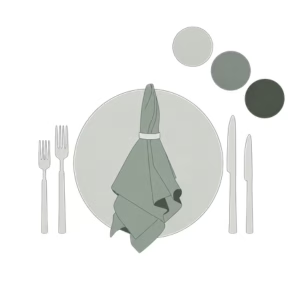
Tableware with plate hole
Width of the deck: approx. 48–54 cm
Recommended space per person: 65–70 cm
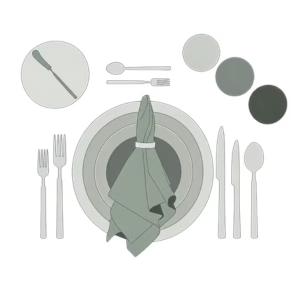
Classic European decor
Width of the deck: approx. 56–64 cm
Recommended space per person: 70–80 cm
The length: So much space per person at the table is really necessary.
60 centimeters per plate is a minimum for a banquet. Not a design goal.
As soon as you start working with plates, things get tighter. A plate dish usually has a diameter of 32 to 33 centimeters. On the left and right of it, cutlery, glasses, napkins, and, if necessary, menu cards must find space. With several courses, it becomes even more challenging.
Therefore, we expect a quiet, high-quality tabletop. at least 65 to ideally 80 centimeters per decoration.
Back to the 2.74-meter table from the opening scene:
With five guests per side, there remains just under 55 centimeters per person. This is feasible if one is very optimistic and does not plan on using very large plates, generous cutlery, or any significant decoration.
With four people at the table per side, there are about 68 centimeters left. And that's exactly where the table starts to breathe.
One less person per side doesn't sound dramatic on paper. In reality, it's exactly that one person who decides whether a table looks elegant or like someone has placed a shoehorn on the tabletop.
The width: Why the table center often disappears
The table length usually receives the most attention during planning. The table width, on the other hand, is often underestimated.
In fact, she is often the real spoiler of the game.
Many classic banquet tables in German rental are about 76 centimeters wide. That sounds like a sufficient table at first glance. But that’s only true as long as the center is not important.
Let’s compare two plates with a diameter of 33 centimeters each; together they already measure 66 centimeters. On a table 76 centimeters wide, theoretically there are 10 centimeters left. In reality, after the rim, glasses, cutlery, and minor adjustments, there’s almost nothing left in the center.
No continuous floral arrangement. No beautiful line of candles. No air.
At 90 centimeters, things are a bit better, but still just enough if the tabletop is designed with more elaborate thought.
Only from about Table width 100 centimeters A truly designable centerpiece is created. Then there is room for flowers, candles, menu cards, or small bowls, without competing with the tablecloths.
For a high-quality wedding concept with place settings, we therefore recommend: at least 100 centimeters table width.
Not because we like it lavishly. Although: of course we do like it lavishly. But above all because the table otherwise cannot deliver what the design demands of it.
Round Tables: Why Ten People Are Rarely Elegant
The classic: a round table with a diameter of 1.80 meters and ten people.
This statement comes up again and again. And it is not completely made up out of thin air. The circumference of a round table with a diameter of 1.80 meters is approximately 565 centimeters. With ten people, that comes to about 56.5 centimeters per guest at the outer edge.
Sounds close, but possible.
The fallacy lies in the fact that a round table does not provide the same amount of space everywhere. Outside, the space is vast. Further inside, where the plates, cutlery and glasses are actually located, the circle becomes narrower.
With ten covers, the outer edge might still work. But the area around the plate and the glasses is quickly crowded. Exactly where it should actually appear quiet and spacious.
Therefore, our honest recommendation regarding the question: how much space a person needs at a table, with a round table with a diameter of 1.80 meters and a high-quality tabletop: eight people.
Eight seem planned. Ten often seem like „we unfortunately had to accommodate someone else.“.
And yes, sometimes you have to do that. But then at least you should know that you are sacrificing a creative decision.
Pool tables: Nice, but difficult to calculate
Wicker tables are beautiful. They add movement to the room, create softer lines than classic tables, and instantly make them more special.
At the same time, they are not calculated like regular banquet tables. A wave table consists of curved segments. This is why the outer arcs and inner arcs differ significantly from each other. There is more length available on the outside, less on the inside.
As an example, let’s take a 90-degree segment with a length of about 255 centimeters and a depth of 100 centimeters. Four of these segments form a closed circle with a diameter of about four meters.
The outer arc of such a segment measures approximately 314 centimeters. The inner arc is approximately 157 centimeters. That is only half.
For the seating arrangement, this means that in the high-quality tabletop setup, for example: five people sit comfortably. On the inner elbow it is more of a two people. Together, this adds up to about seven guests per segment, When they are upholstered inside and out.
More is not impossible. But it quickly gets cramped, especially when platefuls, several glasses and multi-course cutlery are planned.
A particularly beautiful solution is to only furnish the table on the outside and leave the inner edge free. Then the inner line becomes the stage for flowers, candles, and decorations. The table appears more spacious and calmer, and its curved shape is much more pronounced.
Therefore, when it comes to round tables, the question is particularly relevant: Should the table accommodate as many guests as possible, or should it serve as a design element?
Both can only be done to a limited extent at the same time.
Our MoS formula
Magnolias on Silk expects to deliver a high-quality tabletop with a plate holder:
70 to 80 centimeters per decoration
at least 100 centimeters table width
At round tables, there are usually one to two fewer people than the standard table list says.
considered separately for wave tables with external and internal arcs
Generosity is not a waste here. It is the prerequisite for the design to work.
A table doesn’t just have to accommodate guests; it must also create an atmosphere.
The honest reference table
The following overview shows the difference between a functional banquet setup and a high-quality tabletop with flat plates.
Table / Custom-made | Functional setup | MoS setup with plate holder |
|---|---|---|
Dining table 1.22 m | 2 per page / 4 total | 2 per page / 4 total |
Dining table 1.52 m | 3 per page / 6 total | 2 per page / 4 total |
Dining table 1.83 m | 3 per page / 6 total | 3 per page / 6 total |
Dining table 2.00 m | 4 per page / 8 total | 3 per page / 6 total |
Round table 1.20 cm |
6 people |
5 people |
Round table 1.60 m |
8 people |
6 people |
Round table 1.80 m |
10 people |
8 people |
Footboard 90-degree segment, both sides |
7 people |
6 people |
Footstool 90-degree segment, upholstered only on the outside |
5 people |
4 people |
A single banquet table is often no longer than about 2.00 meters in length when rented out. Longer tables are created by assembling several tables together. The space requirement per table remains the same. Only the total length increases.
Are you planning a table plan right now?
For our projects, we use an extensive table planning reference with dimensions, table width options, and recommendations for various table shapes. If you are currently reviewing your table plan or preparing a concept for a couple, you can download the guide here.
HOW MANY GUESTS REALLY FIT ON A DINING TABLE?
So that your table plan works not only on paper:
Our compact reference shows you how many guests fit on round, rectangular, and oval tables – differentiated according to the functional banquet setup and high-quality tabletop with plate holder.
In addition, you will receive guidelines for the width of the centerpieces, the width of the tables, and the question of when there is really room in the center for flowers, candles, and decorations.
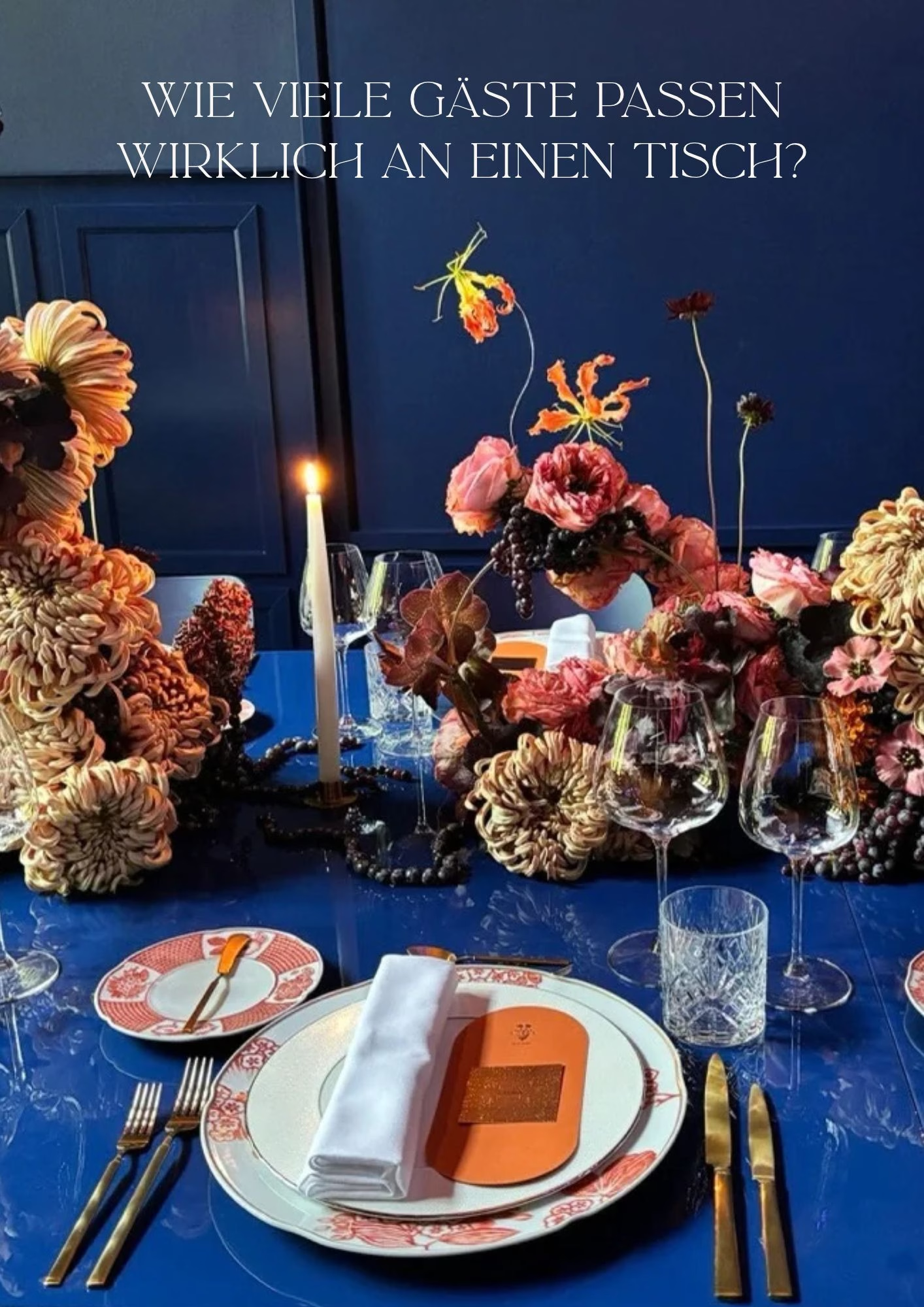
PDF Guide · 6 pages · compact planning reference
Why we are so clear on this issue
Because we see the consequences on the ground.
At a large wedding that we equipped with our White Glove service, we were not involved in the original table planning. On paper, everything was correct. In reality, several problems came together at the same time.
The plates were too narrow for the planned floral decoration. The butter plates had to be moved. There was not enough space between the tablecloths, so cutlery was sometimes under the tablecloth and was difficult to reach for the guests. The round tables with a diameter of 1.80 meters were also cramped with ten people. Especially with several appetizers and additional cutlery, the setup was crowded.
None of this ruins a wedding on its own. But it changes the atmosphere at the table.
And that is exactly what it is about.
The most beautiful tablecloths, the finest plates and the most lovely flowers lose their effect if the table setting lacks space. Luxury is not created by the quantity of things on the table. Luxury is created by proportion.
If you want to know how plates, cutlery and glasses are generally arranged, you’ll find our guide to arranging the table here:
Calculating table spacing: our calculator for uniform table distances
A table only really feels quiet when the upholstery not only has enough space, but is also evenly aligned. This is exactly the question that arises with almost every setup: How large must the distance between the center of the table and the center of the upholstery be so that all the seats are evenly distributed?
Because we have often had to use a calculator ourselves for this, we have built a small calculator. You enter the table shape, table dimensions, and number of guests — and you get the distance between the tablecloths calculated directly. For rectangular tables as well as for round tables.
Spacing between the decorations
Distribute the covers evenly
Conclusion
How much space per person is really needed at the table does not depend solely on the size of the table; it depends on what should happen on that table.
For a simple banquet setup, 55 to 60 centimeters per person may work. For a high-quality tabletop with plates, several glasses, cutlery sets, flowers, and candles, that is too little.
Our recommendation is therefore:
Plane with at least. 70, better up to 80 centimeters per deck, with at least 100 centimeters table width and at round tables, it’s better to have one person less than one too many.
Because the most unpleasant moment is not when a chair is removed from the planning. The most unpleasant moment is when on the day of the event everyone sees that he should never have been allowed to stand there.
Credits:
Photo: Magnolias on Silk
Floristry: Vivko Studio
Location: The Florentin Frankfurt
Planner: Lora Romantics